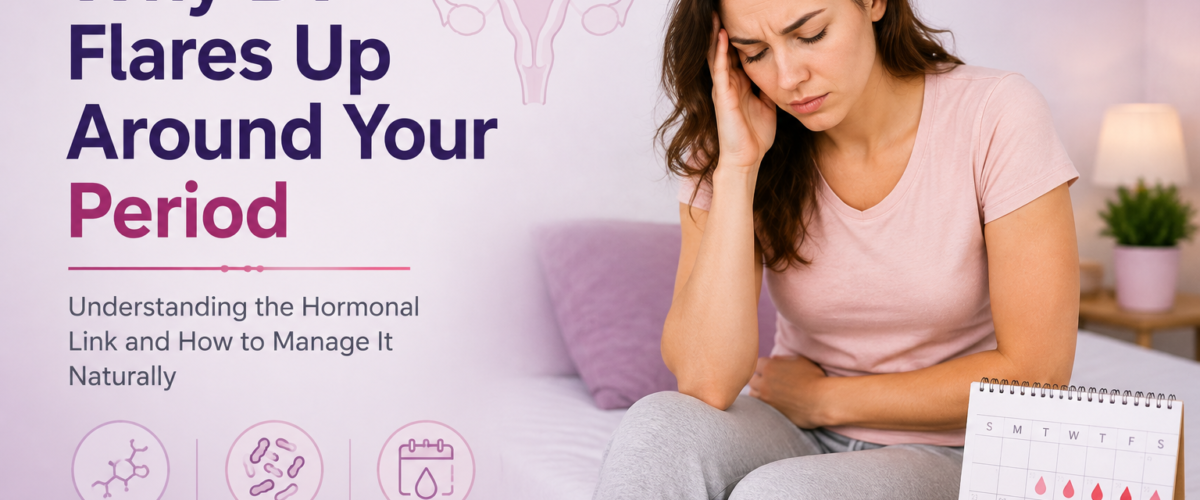
If you notice BV symptoms appearing just before your period, worsening during it, or returning in the days immediately after you are not alone, and you are not imagining a pattern. The link between bacterial vaginosis and your menstrual cycle is real, well-documented, and rooted in the very specific way your period disrupts the vaginal microbiome every single month.
Understanding why BV flares up around your period is the key to doing something meaningful about it rather than treating each episode as an isolated event. This post covers the full biological picture, practical management strategies, and how daily vaginal microbiome support can help break the monthly cycle of recurrence.
The Vaginal Microbiome and Your Menstrual Cycle: A Monthly Disruption
To understand why your period triggers BV, you first need to understand what keeps BV at bay the rest of the time.
A healthy vaginal microbiome is dominated by Lactobacillus bacteria that produce lactic acid, keeping vaginal pH in the protective range of 3.8 – 4.5. That acidity is actively hostile to the anaerobic bacteria particularly Gardnerella vaginalis responsible for BV. As long as Lactobacillus populations are strong and pH stays low, BV-associated bacteria are suppressed.
Your menstrual cycle disrupts this equilibrium in multiple, compounding ways. And they do not just happen during menstruation itself; they begin in the luteal phase before your period arrives and continue as oestrogen rebuilds after it ends. BV is more likely during menstruation and the late luteal phase when Lactobacilli levels drop.
Why BV Flares Before Your Period: The Luteal Phase
Many women notice BV symptoms emerging in the week or so before their period during the luteal phase of the cycle, after ovulation. This is not a coincidence.
Progesterone increases rapidly during the luteal phase, while oestrogen levels vary and decrease in the days leading up to the menstrual period. Oestrogen is essential to the maintenance of the vagina because it stimulates the secretion of glycogen from the cells in the vaginal wall. Glycogen provides nutrition for Lactobacillus. Some women experience symptoms of BV prior to the onset of their period due to hormonal changes in the luteal phase.
With the falling level of oestrogen in the later stages of the luteal phase:
- There is a reduction in glycogen formation in the vaginal epithelium
- Less glycogen means that the fuel for maintaining the Lactobacilli dominance is reduced
- The vaginal pH starts increasing before the start of the menstrual period
- Reduced Lactobacilli count increases infection risk because there are less Lactobacilli and more diverse bacteria
This period, just before the onset of periods, is the one which is most at risk regarding symptoms of BV showing up.
BV Flares During and After Your Period: Four Contributing Factors
It becomes worse once you start menstruating. The pH of menstrual fluid is 7.4, which is a lot higher than the normal vaginal pH, which ranges between 3.8 and 4.5. The minute you start menstruating, the acidic balance which Lactobacillus thrives in becomes disturbed.
Here are the four different ways that your period triggers BV:
1. Menstrual Blood Raises Vaginal pH Directly
Menstrual blood changes the pH of the vagina so it becomes less acidic. A vaginal pH above 4.5 is one of the diagnostic criteria for BV and menstrual blood pushes pH well past that threshold with every cycle. The temporary pH change during your period becomes less acidic, which can favour the growth of BV-causing bacteria rather than clearing them out, making symptoms worse.
This pH rise is not a small shift. It is the removal of the primary chemical defence mechanism that keeps anaerobic bacteria under control and it happens every single month.
2. Menstrual Blood Dilutes and Disrupts Lactobacillus Populations
Menstrual blood dilutes the helpful Lactobacillus bacteria. Even when Lactobacillus populations were adequate before menstruation began, the flow of blood through the vaginal canal physically displaces and washes out protective bacteria reducing their density at exactly the time when the pH environment is becoming most hostile to their recovery.
3. Period Blood Provides Fuel for BV-Causing Bacteria
The protein present in period blood provides a food source for bacteria, leading to flare-ups of BV after every period.The iron in menstrual blood may feed BV-associated bacteria, helping them grow faster and form stubborn biofilms.
This is a particularly important mechanism for understanding recurrent BV around periods specifically. It is not just that the protective environment weakens the nutrients in menstrual blood that actively fuel the growth and biofilm formation of the very bacteria causing the problem.
4. Immune Defences Are Temporarily Lowered
Your body naturally dials back certain immune functions during menstruation. This temporary reduction in local immune signalling part of the body’s management of the inflammatory processes involved in shedding the uterine lining means that the vaginal immune environment is less capable of keeping opportunistic bacteria in check during and immediately after menstruation.
Microbiome impact: Lactobacilli levels drop and vaginal pH also rises due to menstrual blood, which has a neutral pH. Infection risk may be higher due to fewer protective Lactobacilli and increased bacterial diversity.
Does Your Period Flush Out BV?
This is one of the most common misconceptions about BV and menstruation and the answer is a clear no.
Your period does not actually eliminate a BV infection. While menstruation can temporarily change things, the bacteria causing all that trouble stick around. Hormonal changes during your menstrual cycle can sometimes exacerbate the symptoms of BV, making the experience even more uncomfortable.
In fact, if anything, the conditions during menstruation make BV more likely to establish and more difficult to clear without treatment. The raised pH, the bacterial fuel from blood proteins and iron, and the reduced Lactobacillus density all work in the same direction toward BV, not away from it.
How to Manage BV Flares Around Your Period: Practical Strategies
Understanding the mechanisms gives you a clear framework for what to do and when.
Before Your Period (Luteal Phase)
- Start or maintain a daily probiotic for vaginal health the window before your period arrives is when Lactobacillus populations are already beginning to drop. Consistent daily supplementation ensures those populations are as high as possible going into the pH challenge of menstruation
- Monitor symptoms across your cycle keeping a simple log of symptoms tied to your cycle days helps identify your personal pattern and gives your healthcare provider useful diagnostic information
During Your Period
- Change sanitary products regularly changing sanitary products frequently, preferably every 4 – 6 hours, can limit the growth of harmful bacteria by reducing the sustained contact of blood proteins and iron with vaginal tissue
- Use unscented, gentle hygiene products scented tampons, pads, and wipes all add chemical irritants that further destabilise an already vulnerable microbiome. Organic, fragrance-free options reduce that additional stressor
- Avoid douching this cannot be repeated enough. Douching during your period removes whatever Lactobacillus bacteria survive menstruation and accelerates the pH and microbiome disruption that causes BV
- Avoid internal period products if BV is active if you are in the middle of a BV episode, tampons and menstrual cups can introduce bacteria higher into the vaginal canal. External protection may be preferable while treating
After Your Period
- Support your vaginal flora with probiotics – A daily probiotic with Lactobacillus strains may help maintain healthy bacteria populations between periods. The post-period window when oestrogen is climbing back and the vaginal environment is recovering is when a daily synbiotic can do its most meaningful rebuilding work
How Ecotas BV Supports the Monthly Cycle Challenge
Bacterial vaginosis around periods is fundamentally a microbiome recovery problem. The period disrupts the vaginal ecosystem every month. The question is how quickly and completely your Lactobacillus populations can rebound before harmful bacteria establish themselves.
Ecotas BV for vaginal health is designed as a daily capsule for vaginal health that supports that recovery consistently not just when symptoms appear, but through every phase of the cycle.
The four Lactobacillus strains in Ecotas BV each contribute to period-cycle resilience:
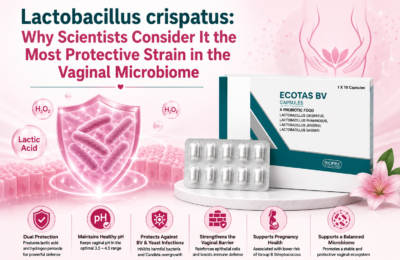
- L. crispatus produces both lactic acid and hydrogen peroxide, rapidly lowering vaginal pH as menstruation ends and creating the hostile environment BV-causing bacteria cannot sustain
- L. rhamnosus competes with Gardnerella vaginalis for epithelial adhesion sites blocking recolonisation of the vaginal walls as the cycle resets
- L. jensenii contributes native territorial competition and additional lactic acid production to accelerate the restoration of a protective acidic environment
- L. gasseri reinforces the protective biofilm that lines the vaginal walls making them physically harder for BV-associated bacteria to adhere to each month
The fructo-oligosaccharides (FOS) prebiotic in the formula feeds all four strains continuously, sustaining their populations through the luteal phase dip and the menstrual disruption rather than allowing populations to fall each cycle and scramble to recover.
Taken consistently as a daily capsule for vaginal health, Ecotas BV gives your microbiome the best possible position at every stage of your monthly cycle building cumulative resilience rather than reacting to each flare.
The Bottom Line
BV flares around your period are not random. They follow a predictable biological pattern: the luteal-phase Lactobacillus dip, the pH disruption of menstrual blood, the bacterial fuel in blood proteins and iron, and the temporary reduction in immune defences all compound against your vaginal microbiome every single month.
The answer is not just to treat each episode, it is to build a vaginal microbiome that is resilient enough to withstand the monthly challenge without tipping into BV every time. That requires consistent, daily microbiome support across the whole cycle, not just reactive treatment during flares.
Ecotas BV for vaginal health is built for exactly that: a daily capsule for vaginal health that supports your Lactobacillus populations through every phase of your cycle, month after month.
Frequently Asked Questions
What causes the foul smell of BV around menstruation?
BV has a foul smell that is stronger around periods since the pH level of menstrual blood (which is 7.4) is alkaline, and this makes the volatile amine that is caused by the bacteria in BV more volatile and thus smelly. The smell is often most pronounced immediately after menstruation ends, or after sex, for the same reason: anything that temporarily raises vaginal pH releases these odour compounds.
Can my period flush out BV naturally?
No. Menstruation will not usually cure BV. Moreover, there is a possibility that the hormonal fluctuations within your menstrual period might worsen the symptoms of BV and make the process more unpleasant for you. The bacteria causing BV and the biofilm they form on vaginal walls remain present throughout menstruation and continue to thrive in the raised-pH environment that period blood creates. Antibiotic treatment remains the clinical standard for clearing active BV.
Why do I keep getting BV after every period?
This recurring pattern happens because the menstrual cycle disrupts the vaginal microbiome in the same four ways every month: raised pH, diluted Lactobacillus bacteria, bacterial fuel from blood iron and proteins, and temporarily reduced immune signalling. If your Lactobacillus populations are not robust enough to rapidly reestablish dominance after each period, BV-associated bacteria colonise the vacancy. A daily synbiotic capsule for vaginal health builds the Lactobacillus population continuously, reducing how far it falls with each cycle.
Is it safe to treat BV during my period?
Yes, antibiotic treatment can be started at any point in the cycle, including during menstruation. It is advisable to start the therapy as soon as the symptoms occur irrespective of your menstrual period. If you are using vaginal antibiotic gel or cream, external protection (pads rather than tampons) may be preferable during treatment.
Does hormonal birth control affect BV risk around periods?
Individuals using hormonal contraceptives such as the pill may be at less risk of BV because of the stabilizing effect of the latter on their hormone levels and menstrual cycle. By reducing the hormonal fluctuation that depletes Lactobacillus during the luteal phase, and often reducing menstrual flow (and therefore the volume of alkaline blood disrupting vaginal pH), hormonal contraception can reduce the frequency of period-associated BV flares in some women.