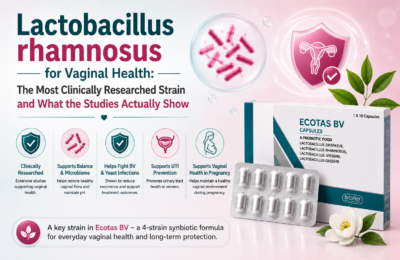
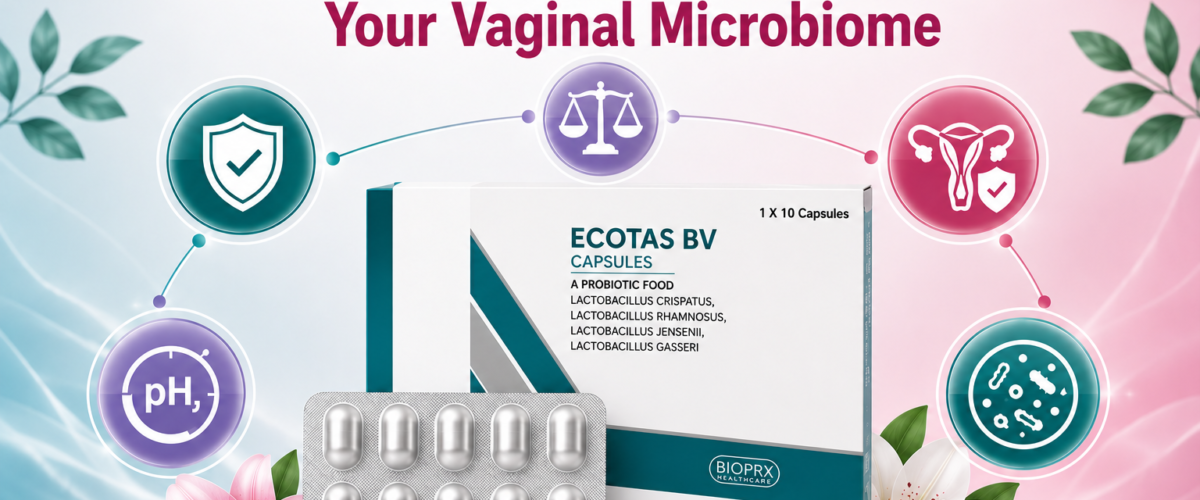
If you have ever read the label on a probiotic supplement and wondered what those long Latin names actually mean for your health this post is for you.
Not all Lactobacillus strains for vaginal health are equal. Different species do different jobs inside the vaginal microbiome. Some are particularly powerful at producing the acids that keep your pH balanced. Others are better at outcompeting harmful bacteria. Some do both. Understanding which strains are in your supplement and what they each do is the difference between choosing a product that genuinely supports your vaginal health and one that simply sounds like it does.
The Ecotas BV capsule contains four clinically recognised Lactobacillus strains, each selected for a specific and complementary role in vaginal microbiome health. Here is exactly what each one does.
Why Lactobacillus Strains Are the Foundation of Vaginal Health
Before we look at the individual strains, it is worth understanding why Lactobacillus species matter so much in the first place.
A healthy vaginal microbiome is dominated by Lactobacillus bacteria. These bacteria produce lactic acid and, in some species, hydrogen peroxide, two natural compounds that keep the vaginal pH between 3.8 and 4.5. That acidic environment is hostile to most pathogens, including the bacteria responsible for bacterial vaginosis (BV), the fungi that cause yeast infections, and many sexually transmitted pathogens.
The most frequently isolated Lactobacillus species in the vaginal microbiome are L. crispatus, L. gasseri, L. jensenii, and L. iners. Residing at the port of entry of bacterial and viral pathogens, vaginal Lactobacillus species can create a barrier against pathogen invasion mainly through products of their metabolism secreted in the cervicovaginal fluid, which play an important role in the inhibition of bacterial and viral infections.
When these protective Lactobacillus strains are outnumbered by antibiotics, hormonal shifts, sexual activity, or stress harmful bacteria move in. Replenishing the right strains through a targeted daily capsule for vaginal health is how Ecotas BV supports your body’s own natural defences.
The Four Lactobacillus Strains in Ecotas BV
Strain 1: Lactobacillus crispatus The Gold Standard of Vaginal Health
If there is one Lactobacillus strain that researchers consistently identify as the most protective for the vaginal microbiome, it is Lactobacillus crispatus.
L. crispatus is considered an important microbial biomarker due to its professed beneficial implications on vaginal health. Studies have proposed that vaginal microbial communities dominated by L. crispatus are more strongly associated with vaginal health than other vaginotypes, making L. crispatus a microbial biomarker of a healthy vaginal microbiome.
What makes L. crispatus so valuable as one of the best Lactobacillus strains for vaginal health:
- It produces both lactic acid and hydrogen peroxide a dual mechanism of protection that most other Lactobacillus species cannot match
- It forms a stable, dense biofilm on the vaginal walls, physically blocking pathogenic bacteria from colonising
- It is the dominant species in the healthiest vaginal microbiome community types identified by researchers
For women recovering from BV or recurrent yeast infections, restoring L. crispatus levels is one of the most clinically meaningful steps possible. It is the strain that, when dominant, most reliably signals a truly healthy vaginal environment.
Strain 2: Lactobacillus rhamnosus The Resilient Defender
Lactobacillus rhamnosus is one of the most researched probiotic strains in human health across any application and its role in vaginal health is among its best-evidenced uses.
Lactobacillus rhamnosus is among the most widely recommended Lactobacillus strains for vaginal health by healthcare professionals, and studies show that Lactobacillus strains may be able to fight cervical pathogens and protect against infection, making it important to maintain a healthy balance of these microorganisms.
What L. rhamnosus brings specifically to Ecotas BV uses:
- Strong evidence for reducing BV recurrence when used alongside or following antibiotic treatment
- Resilient survival through the digestive tract L. rhamnosus is one of the hardier Lactobacillus species, giving it a better chance of reaching the vaginal environment via the gut-vaginal axis
- Inhibits the adhesion of Gardnerella vaginalis and Candida species to vaginal epithelial cells preventing colonisation before it can begin
- Supports both vaginal and gut immune signalling, contributing to broader antimicrobial defences
L. rhamnosus is the strain most commonly cited when women ask about the best Lactobacillus for BV prevention and for good reason. The clinical evidence behind it is substantial.
Strain 3: Lactobacillus jensenii The Native Protector
Lactobacillus jensenii is one of those species which are indigenous to the vagina flora of healthy females. While not receiving much publicity like L. crispatus and L. rhamnosus, this organism’s significance cannot be underestimated.
Vaginal microbiotas dominated by L. crispatus, L. gasseri, or L. jensenii are typically associated with health; all three are among the most protective community types identified in vaginal microbiome research.
What L. jensenii contributes to the Ecotas BV capsule formulation:
- Produces lactic acid that maintains the low vaginal pH essential for excluding BV-associated pathogens
- Competes directly with anaerobic bacteria for space and nutrients on the vaginal epithelial surface
- Particularly effective at inhibiting Gardnerella vaginalis the primary driver of BV biofilm formation
- Works synergistically alongside L. crispatus and L. gasseri to reinforce a multi-species protective community
The presence of L. jensenii in Ecotas BV is a sign of a formula built around how the healthy vaginal microbiome actually looks, not just the most-marketed strains, but the full community of naturally dominant species.
Strain 4: Lactobacillus gasseri The Biofilm Builder and Candida Suppressor
Two especially significant functions of Lactobacillus gasseri are worth mentioning as reasons for including it in any supplement intended for lactobacilli strains in the vagina: it promotes the development of biofilm and inhibits Candida overgrowth.
Lactobacillus gasseri-dominated vaginal microbial communities are among the three most dominant and healthiest vaginotypes identified in microbiome research, alongside L. crispatus and L. jensenii communities.
What L. gasseri specifically contributes to Ecotas BV for vaginal health:
- Helps form the protective biofilm layer on the vaginal walls that physically prevents pathogens from adhering
- Produces lactic acid and antimicrobial bacteriocins small proteins that directly inhibit the growth of harmful bacteria
- Demonstrated capacity to inhibit Candida albicans the most common cause of vaginal yeast infections making it particularly valuable for women who experience both BV and recurrent thrush
- Works as part of the multi-strain community to create a resilient, self-reinforcing vaginal microbiome that is harder to disrupt
Why Four Strains Work Better Than One
Each of the four Lactobacillus strains for vaginal health in the Ecotas BV capsule targets a different aspect of vaginal microbiome protection. This is not accidental; it reflects how the healthy vaginal microbiome actually operates in nature.
Research has demonstrated that multi-Lactobacillus compositions possessing combinations of these vaginal strains show a higher inhibitory activity against Gardnerella vaginalis than any single Lactobacillus strain alone.
When you combine L. crispatus‘s dual-acid production, L. rhamnosus‘s resilient pathogen inhibition, L. jensenii‘s native competitive exclusion, and L. gasseri‘s biofilm and anti-Candida properties the result is a genuinely comprehensive defence system. Each strain fills a gap that the others cannot cover alone.
This is why Ecotas BV uses a four-strain synbiotic rather than a single-strain or two-strain formula.
How Ecotas BV Puts These Strains to Work Daily
The Ecotas BV capsule delivers all four of these clinically recognised Lactobacillus strains alongside fructo-oligosaccharides (FOS), a prebiotic that feeds and sustains them after they are ingested. This synbiotic combination improves colonisation efficiency through the gut-vaginal axis, giving the strains a better chance of reaching the vaginal environment and establishing themselves.
A double-blind, randomised, controlled clinical trial specifically evaluating the combination of L. crispatus, L. gasseri, L. rhamnosus, and L. jensenii the exact four strains in Ecotas BV demonstrated their efficacy in supporting the management of bacterial vaginosis in adult women.
This is not a generic women’s probiotic with vaginal health added as an afterthought. Every ingredient in the Ecotas BV capsule is there for a specific, evidenced reason built around the real biology of how the vaginal microbiome protects itself.
As a daily capsule for vaginal health, Ecotas BV is designed for women who want consistent, strain-level microbiome support whether they are recovering from an infection, preventing a recurrence, or simply maintaining long-term vaginal balance.
The Bottom Line
The four Lactobacillus strains in the Ecotas BV capsule were not chosen at random. L. crispatus, L. rhamnosus, L. jensenii, and L. gasseri are the most clinically recognised, naturally dominant Lactobacillus strains for vaginal health each with a distinct mechanism of protection, and each contributing something the others cannot.
Together, they form a complete, multi-layered daily defence system for your vaginal microbiome. That is what separates Ecotas BV for vaginal health from a standard probiotic and it is why strain selection is the first, most important question to ask when choosing a daily capsule for vaginal health.
Frequently Asked Questions
– Which strains of Lactobacillus are recommended for vaginal wellness?
The most clinically proven Lactobacillus strains in the case of vaginal health include L. crispatus, L. rhamnosus, L. gasseri, and L. jensenii all of which are present in the Ecotas BV capsule. These are the strains that are found to be most predominant in the normal vaginal microflora, specifically for protection from bacterial vaginosis and yeast infections.
– Which lactobacillus is good for bacterial vaginosis?
The best lactobacillus strains for bacterial vaginosis (BV) include L. crispatus, which produces both lactic acid and hydrogen peroxide, as well as L. rhamnosus, which helps prevent recurrence of BV after antibiotic therapy. A multi-strain formula combining both alongside L. jensenii and L. gasseri is more effective than either strain used alone.
– How long does it take for Lactobacillus strains to colonise the vagina?
Colonisation begins within days of starting a daily probiotic supplement, but a meaningful, stable shift in the vaginal microbiome typically takes four to eight weeks of consistent daily use. The gut-vaginal axis pathway means that regular dosing is essential bacteria cannot colonise permanently from a single dose.
– Do I need different Lactobacillus strains for gut health vs vaginal health?
Yes. Probiotics that enhance gut health usually have strains such as L. acidophilus and Bifidobacterium species, which are designed to thrive in the intestinal tract. Strains used in the treatment of vaginal infections include L. crispatus, L. rhamnosus, L. gasseri, and L. jensenii. These strains are especially suitable for use in the vagina because of the different conditions found in this area.