You notice something is off. There is unusual discharge, some discomfort, maybe an odour that was not there before. Your first instinct might be to reach for an over-the-counter antifungal but what if it is not a yeast infection at all?
BV or yeast infection is one of the most common questions women ask and one of the most important to get right. These two conditions share some overlapping symptoms, but they have completely different causes, completely different characteristics, and require completely different treatments. Using the wrong treatment will not only fail to clear the infection it can actively make things worse.
This guide walks you through every key difference between BV and yeast infection, how to identify which one you might be dealing with, why the treatment paths diverge entirely, and how daily vaginal microbiome support can help reduce the risk of both.
What Causes BV vs a Yeast Infection?
Understanding the root cause of each condition is the single most important starting point because these are fundamentally different types of infection.
What Causes Bacterial Vaginosis (BV)?
BV results from an overgrowth of harmful bacteria in the vagina. Specifically, it happens when the Lactobacillus bacteria that normally dominate a healthy vaginal microbiome are outnumbered by anaerobic bacteria most commonly Gardnerella vaginalis, along with Prevotella, Mobiluncus, and other anaerobes.
BV is a bacterial imbalance. It is not an infection introduced from outside, it is a disruption of the bacteria already present in the vaginal ecosystem. With BV, a doctor may find that the pH of the area is higher than 4.5, a sign that the Lactobacillus bacteria that normally produce lactic acid to keep pH low have been depleted.
What Causes a Yeast Infection?
An overgrowth of Candida fungus causes a yeast infection. Candida albicans is naturally present in small amounts in the vagina of most healthy women; it only becomes a problem when the microbiome balance shifts and the fungus is able to multiply unchecked.
A yeast infection is a fungal overgrowth. It is not caused by bacteria at all. This is the core reason that the treatment approaches are entirely separate; antibiotics have no effect on Candida, and antifungals have no effect on BV-causing bacteria.
BV vs Yeast Infection: Symptom Comparison
The symptoms of BV and yeast infection can overlap in ways that make self-diagnosis genuinely difficult. Both can cause vaginal discomfort, abnormal discharge, and general irritation. But the specific characteristics of those symptoms differ in ways that can help you identify which you are dealing with.
Discharge: The Key Symptom
BV presents with a thin discharge that smells fishy while discharge from a yeast infection is thick and odorless.
In more detail:
Discharge from BV:
- Thin, gray in color, and abundant in volume
- It may be white, gray, or yellow in color
- Abundant in volume as compared to normal
- It forms a coating on the vaginal walls like a film
Discharge from yeast infection:
- Thick, white as opposed to thin or watery; usually likened to appearance of cottage cheese
- Thick in texture
- White in colour
- Does not typically have a strong or unusual smell
Odour: The Most Trustworthy Signal at Home
If you can detect a distinct odor accompanied by watery discharge with little or no itching, BV is probably the cause. Thick, clumpy discharge with severe itching and no fishy smell points more toward a yeast infection.
The odour associated with BV is frequently described as fishy and it usually causes a change in odour especially noticeable after a period or after intercourse, because semen and menstrual blood temporarily raise vaginal pH, intensifying the smell produced by BV-associated bacteria.
Yeast infections, by contrast, do not typically impact vaginal odour. Yeast infection discharge usually does not smell out of the ordinary.
Itching and Irritation: The Critical Differentiating Feature
Vaginal irritation: in general, BV doesn’t lead to vaginal irritation or itching. Yeast infections do.
The symptoms associated with yeast infections often include very strong itching both within the vagina and on the skin of the vulva, as well as redness and swelling. The symptoms associated with BV will often not include significant inflammation and the irritation can sometimes even just include minor itching.
If you are experiencing very strong itching particularly on the vulva, then the condition is more likely to be a yeast infection. If the discharge and odour are prominent but itching is mild or absent, BV becomes the more probable diagnosis.
Pain During Sex
While BV can cause irritation, it typically does not cause pain. Yeast infections, on the other hand, can cause pain in addition to itching and burning particularly after intercourse.
Can You Have Both at the Same Time?
Yes, one can have a yeast infection and BV at once. While each infection prefers a different pH environment (yeast favours more acidic and BV favours more basic), they can both exist together. If you are experiencing symptoms that resemble both a yeast infection and BV, you may have a co-infection which can be treated with prescription medications.
Quick Reference: BV vs Yeast Infection
| Symptom | BV | Yeast Infection |
| Discharge texture | Thin, watery | Thick, clumpy (“cottage cheese”) |
| Discharge colour | Grey, white, or yellow | White |
| Odour | Fishy, especially after sex | None or very mild |
| Itching | Mild or absent | Intense, including on vulva |
| Redness/swelling | Uncommon | Common |
| Pain during sex | Uncommon | Common |
| Vaginal pH | Elevated (above 4.5) | Usually normal or slightly low |
| Cause | Bacterial overgrowth | Fungal (Candida) overgrowth |
Why the Treatment Approach Is Completely Different
This is the most critical point and the reason why guessing and self-treating carries real risk.
Treating BV
Your healthcare provider will prescribe antibiotics, typically metronidazole or clindamycin. These medications come in a gel or cream you insert into your vagina. Some antibiotics are pills you can take orally.
Antibiotics target bacteria, specifically the anaerobic bacteria causing the BV imbalance. They do not work against Candida. It is important to finish the antibiotic and take it as your provider prescribes. Stopping early because your symptoms go away increases your risk of getting BV again.
Treating a Yeast Infection
Yeast infections are treated with antifungal medications such as oral fluconazole or topical azoles (clotrimazole, miconazole, terconazole). These are available both on prescription and over the counter.
You can treat yeast infections with over-the-counter medications which is why the temptation to self-treat is so strong. But antifungals have absolutely no effect on BV. Treating BV with an antifungal will not improve symptoms, and the delay in correct treatment can allow BV to worsen.
The danger of misdiagnosis goes further than symptom relief. Having BV makes you prone to sexually transmitted infections and can affect pregnancy. Untreated or incorrectly treated BV carries real downstream health risks which is why a confirmed diagnosis before treatment matters.
When to See a Doctor
Always seek medical diagnosis if:
- Symptoms are new and you have not had this type of infection confirmed before
- Over-the-counter antifungal treatment has not improved your symptoms within three days
- You are pregnant
- Symptoms recur more than twice within six months
- You have any reason to suspect a sexually transmitted infection alongside your symptoms
Home at-home vaginal pH tests can be a useful first indicator; a pH above 4.5 suggests BV is more likely than a yeast infection but they cannot confirm a diagnosis and are not a substitute for clinical testing.
How Ecotas BV Supports Long-Term Protection Against Both Conditions
Whether you are dealing with BV or yeast infection recurrence, the underlying vulnerability is the same: a depleted vaginal microbiome that is not producing enough Lactobacillus bacteria to maintain the protective acidic environment.
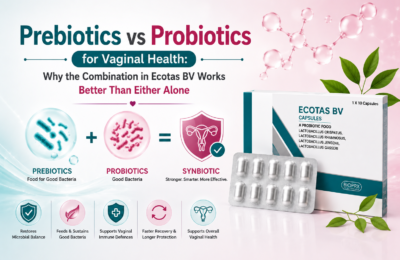
This is where Ecotas BV for vaginal health plays its most meaningful role not as a treatment for active infections, but as a daily support tool that reduces the microbiome conditions that allow both BV and yeast infections to recur.
The four Lactobacillus strains in the Ecotas BV daily capsule for vaginal health each contribute to that protective environment together with fructo-oligosaccharides (FOS) prebiotic, the synbiotic formula in Ecotas BV helps restore and sustain the Lactobacillus-dominant microbiome that naturally suppresses both bacterial and fungal overgrowth reducing the cycle of recurrence that so many women experience.
Ecotas BV for vaginal health is particularly valuable after antibiotic treatment for BV in a context where the vaginal microbiome is often at its most vulnerable to secondary yeast infection, as antibiotics deplete Lactobacillus populations indiscriminately. Daily use of the daily capsule for vaginal health during and after antibiotic treatment helps rebuild that protective flora before Candida seizes the opportunity.
The Bottom Line
BV or yeast infection getting the distinction right matters enormously. Different causes. Different discharge characteristics. Different odour patterns. Different itching intensity. And most critically: completely different treatments that do not work interchangeably.
If you are unsure, always seek a clinical diagnosis before treating. And regardless of which condition you are managing or whether you are simply trying to prevent either from recurring, the foundation of long-term vaginal health is the same: a strong, Lactobacillus-dominant microbiome that keeps both bacterial and fungal imbalance in check.
Frequently Asked Questions
How will I be able to tell if it’s BV or a yeast infection?
The best way to differentiate between the two is the presence of either thin, fishy-smelling discharge or thick, odorless discharge. The first one indicates BV, while the latter indicates yeast infection. Itching in the vagina area indicates yeast infection. A fishy odor also indicates BV, particularly if the smell is evident during and after sexual intercourse and menstrual periods. Nonetheless, symptoms may overlap at times. The most definite way is to seek a clinical diagnosis.
Is it safe to use an OTC yeast infection medication for BV?
No. Over-the-counter antifungal treatments (creams, tablets, suppositories) are designed to kill Candida fungus; they have no effect on the bacteria that cause BV. Using antifungal treatment for BV will not resolve the infection and may delay the correct treatment. BV requires prescription antibiotic therapy.
Can BV turn into a yeast infection?
Not directly BV and yeast infections are caused by entirely different organisms. However, the antibiotics used to treat BV can deplete Lactobacillus populations in the vaginal microbiome, temporarily raising the risk of secondary Candida overgrowth. This is why a post-antibiotic probiotic supplement, a daily capsule for vaginal health, is so valuable after BV treatment.
Why do I keep getting BV and yeast infections alternately?
This pattern is extremely common and reflects chronic microbiome vulnerability. Following antibiotic therapy for BV, there is insufficient recovery of the Lactobacillus before the overgrowth of Candida leading to a yeast infection. The antifungal therapy takes care of the yeast infection while leaving the compromised microbiota prone to the next BV infection. An everyday synbiotic such as Ecotas BV ensures that the Lactobacilli are replenished following each bout of therapy.