
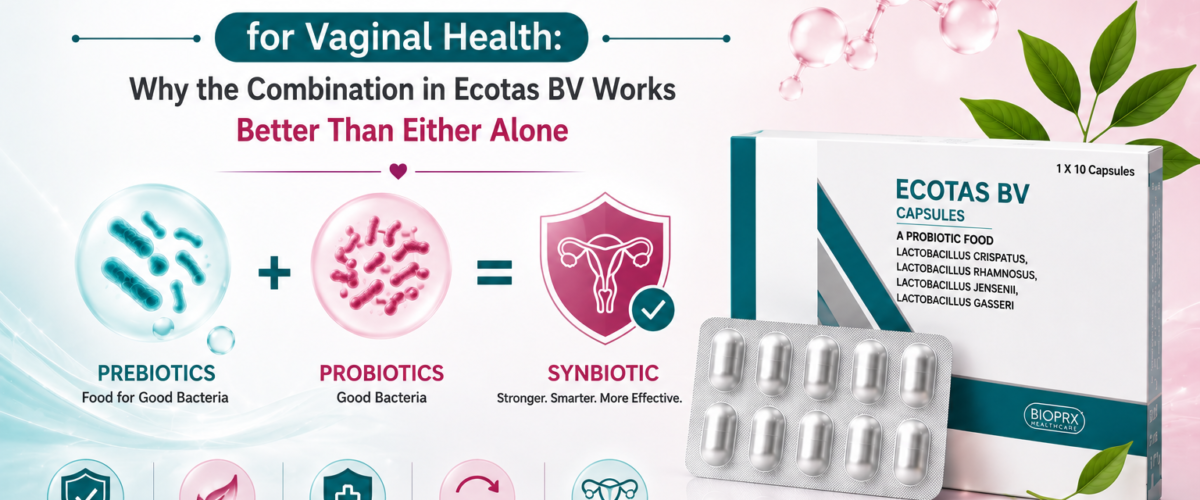
If you have been researching probiotics for vaginal health, you have almost certainly come across the word “prebiotic” too often used interchangeably, rarely explained clearly. And yet, the difference between these two things, and more importantly what happens when you combine them, is one of the most practical things to understand before choosing a vaginal health supplement.
Here is the honest answer upfront: probiotics and prebiotics each do something valuable. But the science consistently shows that combining them in what is called a synbiotic produces better, faster, and more lasting results than either one used alone. That is exactly the principle behind the Ecotas BV formula.
Let’s break it all down clearly.
What Are Probiotics for Vaginal Health?
Probiotics are live beneficial microorganisms bacteria, in the context of vaginal health that, when taken in adequate amounts, directly support the microbial balance of the vaginal microbiome.
A healthy vaginal microbiome is dominated by Lactobacillus species. These bacteria produce lactic acid and hydrogen peroxide, keeping vaginal pH in the protective range of 3.8 – 4.5. When Lactobacillus populations drop after antibiotics, hormonal shifts, or illness the door opens for infections like bacterial vaginosis (BV), yeast infections, and urinary tract infections.
Probiotics for vaginal health work by directly reintroducing the Lactobacillus strains your microbiome needs. Studies have shown that probiotics can restore the balance of bacteria in the vagina by increasing the number of good bacteria, reducing the recurrence of BV, and improving cure rates.
The key word is reintroduce. Probiotics are the bacteria themselves live, active, and capable of colonising your vaginal environment when the right conditions exist.
What Are Prebiotics for Vaginal Health?
Prebiotics are not bacteria. They are non-digestible dietary fibers, typically short-chain carbohydrates like fructo-oligosaccharides (FOS) that your body cannot break down, but that beneficial bacteria can.
Think of it this way. Probiotics deliver live microorganisms, and prebiotics act as the sustenance that helps those probiotics survive and thrive. Prebiotics are the food. Probiotics are the living organisms that eat that food. One is the gardener; the other is the soil.
Prebiotics play an important role in feeding good bacteria in the vagina, improving probiotics’ effectiveness, and increasing their effects on the vaginal ecosystem. This is done in various ways such as promoting the proliferation of Lactobacilli compared to harmful bacteria; by stimulating immunity factors such as cytokines and antimicrobial peptides in the vagina, and by enhancing probiotics’ survival and colonization in the right places.
Importantly, prebiotics do not introduce anything new to the system; they amplify and sustain what is already there, or what probiotics are working to establish.
Prebiotics vs Probiotics: The Key Differences
| Probiotics | Prebiotics | |
| What they are | Live bacteria | Indigestible dietary fibres |
| What they do | Reintroduce beneficial Lactobacillus strains | Feed and sustain those bacteria |
| Where they act | Vaginal and gut microbiome | Lower gut → gut-vaginal axis |
| Examples | L. crispatus, L. rhamnosus, L. gasseri, L. jensenii | FOS (fructo-oligosaccharides), inulin, GOS |
| On their own | Effective, but limited by survival and colonisation challenges | Cannot introduce new bacteria alone |
| Together (synbiotic) | Survive better, colonise more efficiently, and sustain longer with prebiotic fuel support | Selectively feed and amplify the reintroduced Lactobacillus strains, accelerating colonisation and independently activating vaginal immune defences |
Why Neither Works as Well Alone
The Limitation of Probiotics Without Prebiotics
Probiotics for vaginal health have strong clinical backing but they face a significant biological challenge. When you swallow a probiotic capsule, the live bacteria inside it have to navigate your entire digestive system before they reach the colon and begin the gut-vaginal axis pathway to the vaginal microbiome.
That journey is hostile. Stomach acid, bile salts, and digestive enzymes destroy a substantial proportion of live bacteria before they reach the lower intestine. Without a prebiotic to support their survival and fuel their early colonisation, fewer bacteria make it through in a viable state and those that do arrive with fewer resources to establish themselves.
This is not a theoretical concern. It directly affects how quickly and how thoroughly probiotics for vaginal health can work when taken without accompanying prebiotic support.
The Limitation of Prebiotics Without Probiotics
Prebiotics, on the other hand, cannot introduce anything new. If your vaginal microbiome is severely depleted of Lactobacillus as is common during or after a BV episode, after antibiotic treatment, or during certain hormonal phases there are simply not enough beneficial bacteria left for the prebiotic to feed.
A prebiotic in a depleted microbiome is like fuel in an empty tank. The infrastructure to use it is not there yet. Prebiotics work best when the beneficial bacteria they are designed to feed are already present or are being actively reintroduced which is exactly what a probiotic does.
Why the Combination (Synbiotic) Works Better
Synbiotics, a combination of probiotics and prebiotics deliver additional benefits by encouraging the development and activity of beneficial microbes, and are assumed to synergistically optimise the vaginal microbiota and lower the risk of urogenital infections.
The clinical logic is straightforward: taking probiotics and prebiotics together produces synergistic effects the probiotics survive better and colonise more effectively when they have prebiotics to feed on.
In practical terms for vaginal health, this synergistic combination means:
- Improved probiotic survival: FOS prebiotics buffer the Lactobacillus bacteria during the digestive journey, increasing the number that reach the colon viable and active
- Faster colonisation: bacteria that arrive with a ready fuel source (FOS) multiply more quickly, accelerating the restoration of a Lactobacillus-dominant microbiome
- More stable long-term protection: the prebiotic continues to selectively feed the colonising Lactobacillus strains after they arrive, sustaining their competitive advantage over harmful bacteria
- Immune activation: FOS independently stimulates antimicrobial immune peptides in the vaginal tract, adding a protective layer that probiotics alone cannot provide
The best probiotic and prebiotic for women is therefore not a choice between the two; it is a formulation that integrates both into a single, well-designed daily dose.
Practical Signs That Your Vaginal Microbiome Needs Both
Consider a combined synbiotic approach if you regularly experience:
- Recurring BV: especially if antibiotics clear it temporarily but it returns within weeks. It implies that there might be some deficiency in regenerating Lactobacillus. The synbiotic has a significant contribution in enhancing the regeneration process.
- Recurring yeast infections: usually caused by the same factors that result in Candida proliferation. Probiotics which feed Lactobacillus ensure conditions unfavorable for the reproduction of Candida.
- Post-antibiotic vaginal disruption: antibiotics broadly deplete Lactobacillus populations. Starting a synbiotic during or immediately after an antibiotic course gives the protective bacteria the best chance of returning to dominance quickly.
- Hormonal fluctuations: perimenopause, postpartum, or mid-cycle dips in oestrogen all reduce the glycogen that Lactobacillus feeds on. A prebiotic supplement compensates by providing an alternative direct fuel source for vaginal bacteria.
- Persistent vaginal odour or discharge changes: these are often signs of mild, ongoing microbiome imbalance rather than acute infection. Daily synbiotic support can correct that imbalance before it develops into a full episode.
How Ecotas BV Delivers the Synbiotic Advantage
Ecotas BV for vaginal health is built entirely around the synbiotic principle and the formula reflects that in every ingredient choice.
The four targeted Lactobacillus strains in Ecotas BV L. crispatus, L. rhamnosus, L. jensenii, and L. gasseri are the probiotic components. Each was selected for its specific, evidence-backed role in the vaginal microbiome: dual acid and hydrogen peroxide production, BV recurrence reduction, native territorial competition, and anti-Candida activity respectively.
The fructo-oligosaccharides (FOS) in the formula are the prebiotic component. They feed all four probiotic strains, improve their survival through digestion, accelerate their colonisation in the lower gut, and independently stimulate the vaginal immune environment.
Together, they function as a true synbiotic daily capsule for vaginal health, not a probiotic with a token prebiotic added, but a formulation where both components are essential and designed to work together.
That’s why Ecotas BV becomes the best probiotic and prebiotic for women who really want to achieve some permanent change in their vaginal microflora.
The Bottom Line
The debate between prebiotics vs probiotics for vaginal health is really not a debate at all. They are not competitors, they are partners. Probiotics reintroduce the bacteria your vaginal microbiome depends on. Prebiotics make those bacteria survive, thrive, and stay. And when combined in the right synbiotic formula, the outcome for your vaginal health is meaningfully better than either can achieve on its own.
That is the principle behind Ecotas BV for vaginal health, a daily capsule that brings together four targeted Lactobacillus strains and FOS prebiotic in a single, evidence-informed synbiotic formula built for real, lasting vaginal microbiome support.
Frequently Asked Questions
– What is the key difference between prebiotics and probiotics for vaginal health?
The probiotics for vaginal health are live cultures of Lactobacillus bacteria that ensure proper bacterial flora in the vagina. Prebiotics are indigestible fibres like fructo-oligosaccharides. They serve as food for Lactobacillus bacteria and other types of bacteria. Thus, probiotics ensure that there are sufficient amounts of good bacteria in the vagina, and prebiotics are their source of nourishment. Both are valuable; combined in a synbiotic, they are significantly more effective than either alone.
– Do I need both a prebiotic and probiotic for vaginal health?
For the best results, yes. Probiotics reintroduce the Lactobacillus strains your vaginal microbiome needs; prebiotics make sure those bacteria survive digestion, colonise effectively, and are sustained over time. While prebiotics and probiotics don’t need to be taken together, they do work well in tandem and offer additional advantages when they’re combined. The Ecotas BV supplement is an example of such a product, since it provides both prebiotics and probiotics in a single tablet every day.
– Which is the best probiotic and prebiotic for women for vaginal health?
The ideal probiotic and prebiotic for women who require vaginal health would be those which contain clinically proven vaginal strains of lactobacillus such as L. crispatus, L. rhamnosus, L. gasseri, and L. jensenii combined with a prebiotic such as FOS. The synbiotic formulations have been found to perform better than probiotics in themselves. Ecotas BV is one such formulation that contains all the aforementioned strains and FOS.
– How soon will the effect of the synbiotic work on the vaginal tract?
Most women experience improvement in terms of discharge and vaginal odour within two to four weeks of regular daily intake. It will take four to eight weeks to achieve full restoration of the microbiota, which can be determined through lactobacilli dominance and low infection rate. The process is faster through the synbiotic preparation, where FOS aids the bacteria’s colonization.
– Can I take probiotics for vaginal health while on antibiotics?
Yes, and it is especially beneficial for courses of antibiotics, which tend to reduce the numbers of Lactobacilli considerably. The use of synbiotics both during and after the course of antibiotics will help replenish the vaginal flora. Doses of the synbiotic should be spaced no less than two hours from the antibiotic to ensure the viability of the probiotics.