When people talk about vaginal probiotic strains, two names come up almost every time: Lactobacillus crispatus and Lactobacillus rhamnosus. They are the most researched, the most marketed, and the most widely recognised in women’s health circles.
But if you stop at those two, you are missing half the picture.
Lactobacillus gasseri and Lactobacillus jensenii are the quieter members of the vaginal microbiome family, not as famous, but doing genuinely critical work. Understanding their individual roles helps explain why multi-strain formulations outperform single-strain supplements for vaginal health.
Let’s give these two the attention they deserve.
The Vaginal Microbiome: A Community, Not a Single Strain
Before diving into the individual Lactobacillus jensenii benefits and Lactobacillus gasseri benefits, it helps to understand how the vaginal microbiome actually works.
A healthy vaginal microbiome is not a single-species environment. Researchers have identified five distinct vaginal microbiome community types in women, four of which are dominated by a specific Lactobacillus species and L. crispatus, L. gasseri, and L. jensenii each anchor one of those three healthy community types. When any one of these species is depleted, the protective community it anchors becomes vulnerable.
This is why choosing vaginal probiotic strains based purely on popularity misses the biological reality. The vaginal microbiome is a collaborative defence system. L. gasseri and L. jensenii are not backup players; they are co-leads in their own right.
Lactobacillus jensenii: The Native Resident That Science Has Underestimated
What Is Lactobacillus jensenii?
Lactobacillus jensenii is a naturally occurring inhabitant of the healthy female lower reproductive tract. It is one of the four key “good bacteria” found in the vaginas of healthy women, and in a well-balanced vaginal microbiome, L. jensenii can make up around a quarter of all vaginal bacteria, a significant presence that most probiotic labels never mention.
Despite this, it remains one of the least talked-about vaginal probiotic strains in mainstream women’s health conversations. That is starting to change as the research catches up.
Lactobacillus jensenii Benefits for Vaginal Health
Lactobacillus jensenii performs several protective functions that make it an important part of any complete Lactobacillus jensenii vaginal health strategy:
Lactic acid and hydrogen peroxide production – L. jensenii produces moderate to high levels of lactic acid, which lowers vaginal pH into the healthy 3.8-4.5 range. This acidity acts as a natural shield, preventing overgrowth of unwanted microbes like Gardnerella vaginalis, the primary driver of bacterial vaginosis (BV). Alongside lactic acid, L. jensenii produces hydrogen peroxide, which has been associated with a decreased rate of BV, reduced risk of gonorrhoea and HIV acquisition, and lower rates of pelvic inflammatory disease.
Direct inhibition of BV-causing bacteria – L. jensenii isolates have demonstrated strong inhibitory activity against Gardnerella vaginalis and Prevotella bivia two of the most common bacteria implicated in BV. These Lactobacillus jensenii benefits go beyond simply acidifying the environment; L. jensenii actively competes with pathogens for space and resources on the vaginal epithelial surface.
Reduced preterm birth risk – A stable colonisation of L. jensenii in the vaginal microbiome is associated with a decreased risk of preterm birth, a significant finding for pregnant women managing vaginal health. Healthy vaginal L. jensenii populations form part of the protective microbial environment that research increasingly links to better pregnancy outcomes.
Reinforcing the protective multi-strain community – A bacterial mixture combining L. crispatus, L. jensenii, and L. gasseri has been shown to produce synergistic inhibitory effects against Gardnerella vaginalis effects that are greater than any single strain used alone. L. jensenii is not just a supporting character; it is part of what makes the full team work.
Lactobacillus gasseri: The Candida Fighter With a Hidden Talent
What Is Lactobacillus gasseri?
Lactobacillus gasseri is one of the dominant Lactobacillus species in the healthy vaginal microbiome and one of the key vaginal probiotic strains whose community type is consistently associated with vaginal health. As a genus, it is especially extensively researched due to its antimicrobial properties and efficacy against pathogens associated with BV, Candida, and even UTIs.
Lactobacillus gasseri Benefits for Vaginal Health
Highly potent against Candida species. Another one of the highly beneficial Lactobacillus gasseri health benefits is its inhibitory effect on Candida species, specifically Candida albicans. Research shows that certain L. gasseri strains modulate acetate production in the vaginal environment in a way that actively suppresses Candida growth. In a separate study, it was found that certain strains of L. gasseri had an anti-pathogen effect on G. vaginalis, F. vaginae, and C. albicans exceeding 90%, which is an extremely wide range of effects for both BV-causing and candidal pathogenic strains.
Production of biosurfactants: L. gasseri produces natural compounds known as biosurfactants, which interfere with the adhesion capabilities of pathogens to the vaginal epithelium. Lack of adhesion means that pathogens have no way of establishing their colonization. The use of such a surface-level approach represents a particularly unique advantage that goes beyond what is achieved using L. crispatus and L. jensenii through acid production.
Bacteriocin production: Beyond lactic acid, L. gasseri bacteriocins are small antimicrobial proteins that directly inhibit the growth of competing bacteria. These compounds target BV-associated anaerobes and help maintain the bacterial balance that a healthy vaginal microbiome depends on.
Mucosal immune support: L. gasseri boosts the function of the mucosal immune system through interaction with the vaginal epithelial and lymphoid tissue. This immune-modulating role means that L. gasseri does not just fight pathogens directly it also helps prime your body’s own defences to do the same.
Survival through the digestive tract: L. gasseri demonstrates good acid resistance and bile resistance, which means it has a strong chance of surviving the journey from gut to vaginal microbiome via the gut-vaginal axis. For a probiotic taken orally as a daily capsule for vaginal health, survivability through the digestive tract is essential, and L. gasseri is well suited to it.
How Lactobacillus jensenii and Lactobacillus gasseri Work Together
Neither L. jensenii nor L. gasseri works in isolation and neither should your probiotic.
When combined with L. crispatus and L. rhamnosus, the complete four-strain combination creates layered, complementary protection across every mechanism of vaginal defence:
- L. crispatus dominates acid and H₂O₂ production
- L. rhamnosus provides resilient pathogen inhibition and immune signalling
- L. jensenii contributes native territorial competition and hydrogen peroxide reinforcement
- L. gasseri brings anti-Candida biosurfactants, bacteriocins, and mucosal immune priming
No single vaginal probiotic strain covers all of these mechanisms alone. A multi-strain formula that includes all four is not just better, it is closer to how the healthy vaginal microbiome actually functions.
How Ecotas BV Puts Both Strains to Work
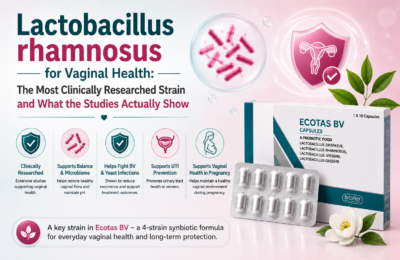
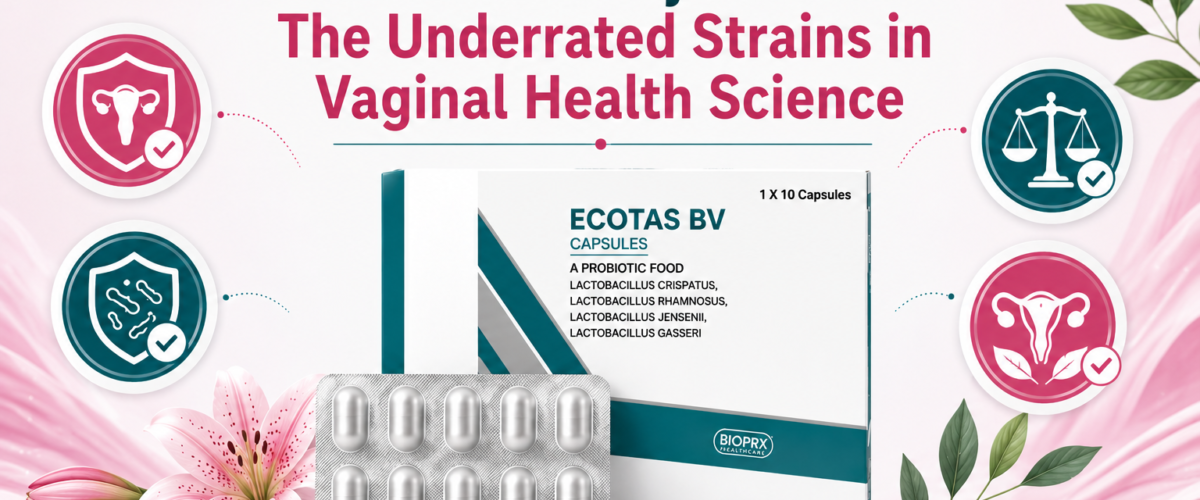
Ecotas BV for vaginal health is one of the few formulations to include all four clinically recognised vaginal Lactobacillus strains including both L. jensenii and L. gasseri alongside L. crispatus and L. rhamnosus.
This is a deliberate formulation choice grounded in the evidence on how these vaginal probiotic strains function together. A completed double-blind, randomised, controlled clinical trial specifically evaluated this four-strain combination for its effect on bacterial vaginosis confirming what the individual strain research already suggested: that the multi-strain approach outperforms narrower formulations.
The daily capsule for vaginal health also includes fructo-oligosaccharides (FOS) as a prebiotic, which feeds and sustains all four Lactobacillus strains after ingestion improving colonisation efficiency through the gut-vaginal axis.
Whether your primary concern is BV, recurrent yeast infections, pregnancy vaginal support, or simply long-term microbiome maintenance, Ecotas BV for vaginal health ensures that L. gasseri and L. jensenii are part of your daily protective strategy not an afterthought.
The Bottom Line
Lactobacillus gasseri and Lactobacillus jensenii may not be the loudest names in vaginal probiotic strains marketing, but the science behind them is genuinely impressive. Together, they fill critical protective roles that the more-celebrated strains cannot cover alone from anti-Candida biosurfactants to native bacterial competition and hydrogen peroxide production.
Choosing a probiotic that includes all four core vaginal Lactobacillus strains is not just about following the science. It is about giving your vaginal microbiome the full community it needs to protect itself. Ecotas BV for vaginal health does exactly that every single day.
Frequently Asked Questions
– What are the benefits of Lactobacillus jensenii to vaginal health?
The key Lactobacillus jensenii vaginal health benefits include lactic acid and hydrogen peroxide production that maintains protective vaginal pH; direct inhibition of Gardnerella vaginalis and other BV-associated bacteria; reduced risk of preterm birth when colonisation is stable; and synergistic multi-strain anti-BV activity when combined with L. crispatus and L. gasseri. L. jensenii naturally makes up around a quarter of a healthy vaginal microbiome.
– What does Lactobacillus gasseri do for vaginal health specifically?
Lactobacillus gasseri benefits for vaginal health include anti-Candida activity that helps prevent and manage yeast infections; biosurfactant release that blocks pathogen adhesion to vaginal walls; bacteriocin production that inhibits BV-associated anaerobes; mucosal immune support; and good digestive survivability for oral probiotic delivery. It is one of the dominant species in the three healthiest vaginal community types identified by microbiome researchers.
– Are these strains safe to take daily?
Yes. L. gasseri and L. jensenii are two species that occur naturally in the healthy vaginal flora and have been recognized as Generally Recognized as Safe (GRAS). They can be safely consumed orally in a daily probiotic supplement. Just like with other dietary supplements, seek professional advice before consuming these bacteria if pregnant or nursing.
– Why are Lactobacillus jensenii and Lactobacillus gasseri less talked about than other strains?
Largely because research funding and clinical trials have historically focused on the most commercially marketed strains particularly L. rhamnosus GR-1 and L. reuteri RC-14. L. jensenii and L. gasseri are native vaginal strains with strong evidence behind them, but they require more specialised culturing and strain-matching work. The science on vaginal flora has come a long way, and these probiotics are now getting their proper due.
– Do I need L. jensenii and L. gasseri in my probiotic supplement?
Yes, because each strain protects through a different mechanism. L. jensenii specialises in native territorial competition and hydrogen peroxide reinforcement; L. gasseri specialises in anti-Candida biosurfactants and bacteriocin production. A daily capsule for vaginal health that includes both alongside L. crispatus and L. rhamnosus provides the kind of layered, multi-mechanism protection that single- or two-strain supplements simply cannot.