If you have spent any time reading about probiotics for vaginal health, one name appears more consistently than almost any other: Lactobacillus rhamnosus. It is not a coincidence. Of all the Lactobacillus strains studied in the context of women’s intimate health, L. rhamnosus has accumulated the largest, most varied body of clinical research spanning bacterial vaginosis, yeast infections, UTI prevention, and pregnancy outcomes.
But what does the evidence actually say? Not the marketing version, the real, nuanced, clinical picture. That is what this post covers.
Understanding the genuine evidence behind Lactobacillus rhamnosus for vaginal health helps you make a better decision about your supplement routine and understand exactly why it is one of the four strains at the core of the Ecotas BV daily capsule for vaginal health.
What Is Lactobacillus rhamnosus?
Lactobacillus rhamnosus is a gram-positive, rod-shaped bacterium in the Lactobacillaceae family. It is naturally found in the human gut and in healthy women in the vaginal microbiome. Unlike some other Lactobacillus species that are primarily native vaginal residents, L. rhamnosus is particularly versatile: it survives the digestive tract well, colonises the gut effectively, and travels through the gut-vaginal axis to establish a protective presence in the vaginal environment.
This digestive resilience is one of the key reasons L. rhamnosus is so widely used in oral probiotic formulations for vaginal health it can actually survive the journey from capsule to colon to vaginal microbiome, which not every probiotic strain manages.
Several clinically studied strains of L. rhamnosus exist. The most researched for women’s health include:
- GR-1®: the most extensively studied strain globally for vaginal health; the basis of dozens of randomised controlled trials
- HN001™: studied specifically in pregnancy contexts with promising results for vaginal flora support
- CA15: a more recently characterised strain with compelling clinical trial data published in 2025
- TOM 22.8: isolated directly from the vaginal ecosystem of a healthy woman; studied for its direct vaginal colonisation capacity
What the Clinical Studies Actually Show
Lactobacillus rhamnosus for BV: Does It Work?
The short answer is yes with important nuance.
As a standalone treatment for BV, L. rhamnosus alone is not a replacement for antibiotics. The clinical consensus is clear: antibiotic therapy (metronidazole or clindamycin) remains the first-line treatment for an active BV episode. Where the evidence for Lactobacillus rhamnosus for BV is strongest is in its role alongside or after antibiotic treatment.
A randomised, placebo-controlled trial of 64 healthy women given daily oral capsules of Lactobacillus rhamnosus GR-1 alongside another Lactobacillus strain showed restoration from asymptomatic bacterial vaginosis microflora to a normal Lactobacillus-colonised microflora in 37% of women during treatment compared to just 13% on placebo. The study also confirmed a significant depletion in vaginal yeast at day 28 and a significant reduction in coliforms at days 28, 60, and 90 for the probiotic-treated group versus controls.
The hypothesis that L. rhamnosus GR-1 combined with L. reuteri RC-14 might provide an adjunct to antimicrobial treatment and improve cure rates of BV has been evaluated in multiple trials. The outcomes achieved through the combination proved to be much better than those achieved by just using antibiotics alone in different populations studied.
Based on a comprehensive randomized and placebo-controlled study conducted in 2025 using the strain of L. rhamnosus CA15, the oral consumption of the probiotic proved to have several advantages in relation to clinical symptoms of vaginal dysbiosis and its microbiome composition. Participants in the active group also reported improvements in physical and psychological health, social relations, and overall quality of life with no significant changes observed in the placebo group.
It is worth being balanced about the evidence, one Chinese cohort study of 126 women found no significant difference in 30-day or 90-day BV cure rate between the adjunctive probiotic group and the metronidazole-only group, noting that probiotic species were rarely detected in vaginal or faecal microbiota after oral administration. This result underscores an important reality: strain choice, dose frequency, and the combination of strains all affect outcomes. L. rhamnosus works best within a multi-strain formulation supported by a prebiotic not as a single-strain oral supplement in isolation.
Lactobacillus rhamnosus for Yeast Infections
Lactobacillus rhamnosus for yeast infection prevention has solid supporting evidence, distinct from its BV applications.
L. rhamnosus GR-1 in combination with a second Lactobacillus strain achieved a significant depletion of vaginal yeast at day 28 compared to placebo in a randomised trial of healthy wome demonstrating a meaningful anti-Candida effect from oral supplementation alone.
Research on the L. rhamnosus TOM 22.8 strain isolated directly from the vagina of a healthy woman showed broad-spectrum antagonistic activity against vaginal pathogens, including adhesion capacity to vaginal epithelial cells and anti-inflammatory and antioxidant activities, with both oral and vaginal administration significantly reducing pathogens within ten days.
The mechanism is well understood. L. rhamnosus inhibits Candida albicans adhesion to vaginal epithelial cells, competes for colonisation sites, and lowers vaginal pH through lactic acid production collectively creating an environment where Candida finds it significantly harder to establish the overgrowth that leads to symptomatic yeast infection.
For women who experience both recurrent BV and recurrent yeast infections a common pattern Lactobacillus rhamnosus for vaginal health addresses both susceptibilities through the same core mechanism: restoring and sustaining the acidic, Lactobacillus-dominant microbiome that keeps multiple opportunistic pathogens in check simultaneously.
Lactobacillus rhamnosus for Pregnancy and UTI Prevention
Long-term vaginal administration of L. rhamnosus after oral treatment with metronidazole to prevent BV recurrence was shown to effectively maintain a balanced vaginal ecosystem in 96% of patients. This finding is particularly significant during pregnancy, where BV is associated with obstetric complications including preterm labour, premature rupture of membranes, and post-Caesarean endometritis.
Early research on L. rhamnosus GR-1 showed that vaginal repopulation following antibiotic therapy also reduced recurrence of urinary tract infection, an important co-benefit given that BV-associated dysbiosis and UTI susceptibility frequently occur in the same women.
L. rhamnosus HN001™ has shown particularly impressive results in supporting vaginal health and managing both BV and recurrent vaginal candidiasis in randomised placebo-controlled trials, making it one of the most recommended strains by healthcare professionals for women’s vaginal health management.
Why Strain Identity Matters More Than the Name
One practical lesson from the clinical literature on Lactobacillus rhamnosus for vaginal health is that not all L. rhamnosus strains are equal. GR-1® has the deepest research archive. HN001™ has strong pregnancy-specific data. CA15 has the most recent large-scale trial data. TOM 22.8 was specifically isolated from the vaginal microbiome itself.
When evaluating a daily capsule for vaginal health, the strain designation behind the name matters far more than the genus and species alone. A supplement that lists “Lactobacillus rhamnosus” without specifying which strain is working from a far weaker evidence base than one that names a clinically studied strain explicitly.
This is not a minor technical detail. It is the difference between a formulation with decades of human clinical data behind it and one that simply shares a species name with the studied strains.
How Ecotas BV Puts Lactobacillus rhamnosus to Work
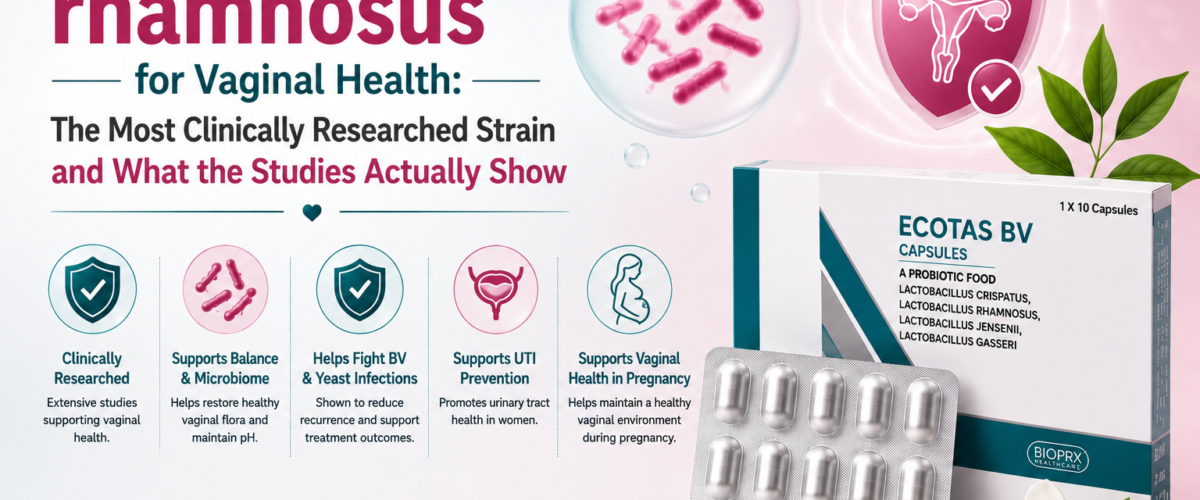
Ecotas BV for vaginal health includes Lactobacillus rhamnosus as one of four targeted strains in its daily synbiotic capsule for vaginal health alongside L. crispatus, L. jensenii, and L. gasseri. This four-strain combination was specifically selected and evaluated in a completed, double-blind, randomised controlled clinical trial for its effects on bacterial vaginosis in adult women.
Within the Ecotas BV formulation, L. rhamnosus plays its most clinically supported role: as the resilient, gut-surviving, BV-fighting, anti-Candida strain that complements the dual-acid production of L. crispatus, the native territorial competition of L. jensenii, and the biosurfactant and bacteriocin activity of L. gasseri.
The fructo-oligosaccharides (FOS) prebiotic in the formula feeds and sustains L. rhamnosus and all four strains through the digestive journey, improving colonisation efficiency through the gut-vaginal axis and addressing one of the key limitations identified in some oral probiotic trials: insufficient survival and delivery of bacteria to the vaginal environment.
Whether your concern is Lactobacillus rhamnosus for BV, yeast infection prevention, pregnancy vaginal support, or long-term daily microbiome maintenance Ecotas BV for vaginal health delivers the strain, the synbiotic support, and the full four-strain community that the evidence consistently points toward.
The Bottom Line
The clinical evidence behind Lactobacillus rhamnosus for vaginal health is genuinely extensive and genuinely nuanced. It is not a magic bullet used alone. But as part of a multi-strain, prebiotic-supported daily capsule for vaginal health, it is one of the most well-evidenced tools available for managing BV, reducing yeast infection recurrence, supporting vaginal health in pregnancy, and maintaining a protective vaginal microbiome over time.
That is exactly the role it plays in Ecotas BV for vaginal health one strand in a comprehensive, evidence-informed four-strain synbiotic formula built around how the vaginal microbiome actually protects itself.
Frequently Asked Questions
– What are the benefits of Lactobacillus rhamnosus for vaginal health?
The mechanism of action of Lactobacillus rhamnosus in vaginal health includes such functions as the production of lactic acid to decrease the acidity of vagina, competition with bacteria causing BV and Candida for epithelial receptors, inhibition of colonization by pathogens, and immune response support. This strain is one of the most researched probiotic strains for human vaginal health.
– Is Lactobacillus rhamnosus helpful in BV?
Yes, as a supplement to the course of antibiotics and as a daily preventive measure. It has been proven through clinical trials that the use of Lactobacillus rhamnosus in BV results in better recovery of normal vaginal microflora after the use of antibiotics compared to placebo. Results are strongest when a clinically validated strain (such as GR-1® or HN001™) is used within a multi-strain, prebiotic-supported formulation.
– Can Lactobacillus rhamnosus help with yeast infections?
Yes, the use of Lactobacillus rhamnosus as a prophylactic against yeast infections has been well-researched. There are many clinical studies which show that L. rhamnosus is capable of reducing the presence of Candida in the vagina and preventing Candida albicans from adhering to vaginal cells. It is highly beneficial for women suffering from recurring cases of thrush.
– How long does Lactobacillus rhamnosus take to work for vaginal health?
The majority of women usually experience changes in the consistency of vaginal discharge and smell between two and four weeks of regular daily use. The complete replenishment of the vagina with a Lactobacillus-dominated vaginal flora usually requires four to eight weeks. Research confirms that L. rhamnosus improves vaginal flora on day 28 and day 60 of supplementation.
– Is it safe to use Lactobacillus rhamnosus every day?
Yes. Multiple randomised controlled trials confirm that daily oral supplementation with Lactobacillus rhamnosus is safe and well tolerated, with no serious adverse effects reported. A daily capsule for vaginal health containing L. rhamnosus as part of a multi-strain synbiotic formula like Ecotas BV is designed for consistent, long-term use which is where its clinical benefits are most reliably demonstrated.