Of all the bacteria that live in the female body, one has earned a title that no other microbe in women’s health has managed to claim: the gold standard of vaginal protection.
Lactobacillus crispatus is not just a common vaginal bacterium, it is the species that scientists consistently identify as the single most protective presence a woman’s vaginal microbiome can have. When L. crispatus is dominant, infections become less frequent, pH stays stable, and the environment becomes significantly harder for harmful bacteria and fungi to colonise.
Understanding why Lactobacillus crispatus deserves this status and what happens to vaginal health when it is depleted is one of the most practical things you can learn about your intimate health. Here is everything science tells us.
What Is Lactobacillus crispatus?
Lactobacillus crispatus is a rod-shaped, lactic acid-producing bacterium that is one of the most prevalent species in the healthy female vaginal microbiome. Researchers have classified the vaginal microbiome into distinct community state types (CSTs) based on which Lactobacillus species dominates and CST-I, the community type dominated by L. crispatus, is consistently the most stable and most protective of all.
A vaginal microbiota dominated by Lactobacillus and specifically by Lactobacillus crispatus is considered a hallmark of vaginal health. It is not just one of several equally valid microbiome states; it is the one that correlates most strongly with reduced infection risk, lower inflammation, and better reproductive outcomes across the published research.
When L. crispatus is dominant, it keeps the vaginal environment balanced, stable, and resistant to disruption. When it is depleted by antibiotics, hormonal changes, sexual activity, or stress the protective community it anchors weakens, and harmful bacteria find it far easier to establish themselves.
Why Lactobacillus crispatus Is the Most Protective Vaginal Strain
1. It Produces Both Lactic Acid and Hydrogen Peroxide a Dual Protection Mechanism
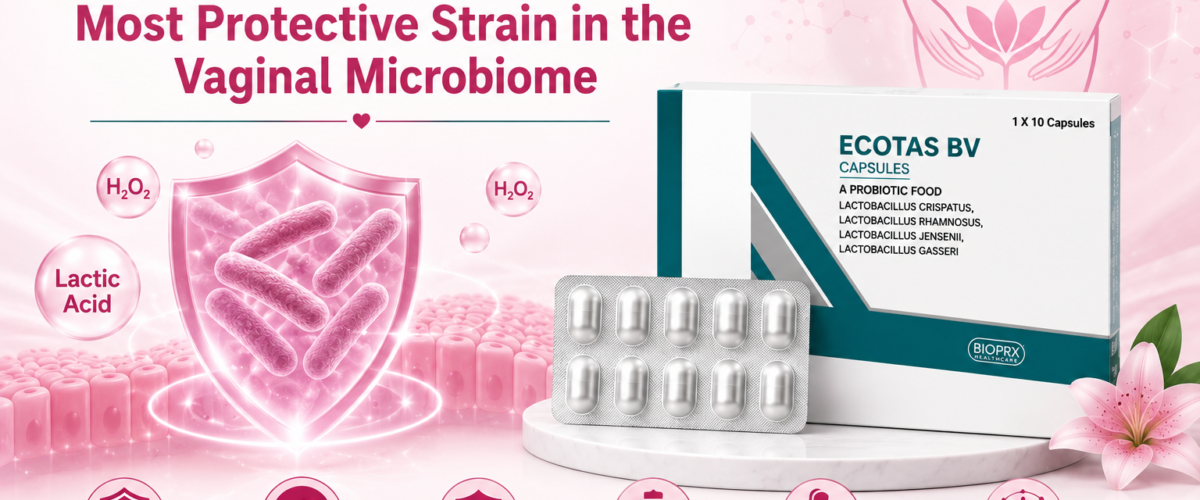
Most Lactobacillus species produce lactic acid. Lactobacillus crispatus produces both lactic acid and hydrogen peroxide and that dual mechanism is what sets it apart from almost every other vaginal probiotic strain.
By reducing vaginal pH to the optimal 3.5 – 4.5, lactic acid ensures the presence of an acidic environment in which no pathogens can thrive. Hydrogen peroxide adds a second layer of antimicrobial activity, directly targeting bacteria that are resistant to acidic conditions alone.
Crucially, L. crispatus produces D-lactic acid as well as the more common L-lactic acid. Research has shown that D-lactate is more protective against unfavourable vaginal communities than L-lactate alone and its levels are highest precisely when L. crispatus is the dominant species. No other vaginal Lactobacillus strain produces this combination as consistently or as potently.
2. Lactobacillus Crispatus Is a Biomarker of Vaginal Health
It is an important statement backed up by a lot of research. The reason why lactobacillus crispatus is regarded as an important biomarker is that it has positive implications for vaginal health. Studies have proposed that vaginal microbial communities dominated by L. crispatus are more strongly associated with vaginal health than any other community type.
In plain terms: if your vaginal microbiome is tested and L. crispatus is dominant, that finding itself is a positive health indicator. The presence of this strain is not just a sign of health in the scientific literature, it is considered a definition of it.
3. It Protects Against Bacterial Vaginosis
BV is the most common vaginal infection worldwide and the relationship between Lactobacillus crispatus and BV is one of the most consistent findings in vaginal microbiome research. Women whose microbiomes are dominated by L. crispatus have significantly lower rates of BV than those with any other community type.
Clinical trials have specifically evaluated L. crispatus as a probiotic for BV prevention and treatment with compelling results. One L. crispatus strain was shown to halve the recurrence of BV in patients compared to the placebo group. Lactin-V, a L. crispatus intravaginal suppository, showed reductions in both repeat UTIs and BV in clinical testing, demonstrating that L. crispatus can successfully and durably colonise the vaginal environment when properly delivered.
The mechanism is clear: L. crispatus outcompetes Gardnerella vaginalis the primary driver of BV for epithelial attachment sites, while simultaneously acidifying the environment to levels where Gardnerella cannot establish the biofilm that makes BV so recurrence-prone.
4. It Reinforces the Vaginal Epithelial Barrier
A less discussed but critically important function of Lactobacillus crispatus is its ability to repair and reinforce the physical barrier of the vaginal wall itself. Research on L. crispatus CCFM1339 showed that the strain strengthened cellular monolayer integrity, promoted cellular migration and repair, reduced inflammatory biomarkers in vaginal tissue, and significantly increased secretory IgA the immune antibody that lines the vaginal mucosa and intercepts pathogens before they can penetrate deeper tissue.
This function of fortifying the barrier system does not stop with balancing the microbiome. Lactobacillus crispatus works towards ensuring that the vaginal lining itself is structurally sound and immune competent, turning the vaginal environment not only into a chemically inhospitable environment for pathogens, but one that is also difficult to penetrate.
5. It Prevents Yeast Infections
The same two-pronged approach that makes Lactobacillus crispatus such an efficient fighter against BV-causing bacteria also prevents Candida albicans, which causes yeast infections. When L. crispatus is present at dominant levels, it inhibits Candida adhesion to vaginal epithelial cells and disrupts the conditions that allow fungal overgrowth to take hold.
For women who experience both BV and recurrent yeast infections a common pattern restoring L. crispatus dominance addresses both susceptibilities simultaneously.
6. It Protects Against Group B Streptococcus in Pregnancy
One of the most important findings in recent Lactobacillus crispatus research concerns pregnancy. A study analysing vaginal cultures from 1,860 pregnant women in their third trimester found that L. crispatus was the most commonly isolated Lactobacillus species. Crucially, colonization by L. crispatus has been shown to have a very high correlation with being protected from Group B Streptococcus (GBS), which is an infection that can potentially be transferred to infants during childbirth.
The female participants that had L. crispatus in their microflora were found to be associated with lower levels of GBS than those participants that did not contain L. crispatus. When talking about pregnant females, it is important to note how essential L. crispatus is for both of them.
What Depletes Lactobacillus crispatus?
Understanding what lowers L. crispatus levels is as important as knowing why the strain matters. The most common causes of depletion include:
- Antibiotics: broad-spectrum antibiotics reduce all Lactobacillus populations, including L. crispatus, even when targeting an unrelated infection
- Hormonal fluctuations: falling oestrogen (during menstruation, perimenopause, or postpartum) reduces the glycogen availability that Lactobacillus crispatus depends on for energy
- Sexual activity: alkaline semen temporarily raises vaginal pH, disrupting L. crispatus dominance, particularly without barrier protection
- Vaginal douching: one of the fastest ways to strip the protective L. crispatus community from the vaginal walls
- Stress: elevated cortisol has been linked to microbiome disruption, including reduced Lactobacillus populations
Once L. crispatus levels drop, the window for other bacteria including BV-associated anaerobes to colonise opens rapidly. This is why proactive, daily support through the right vaginal probiotic strains matters even when you are not actively experiencing an infection.
How Ecotas BV Supports Lactobacillus crispatus Every Day
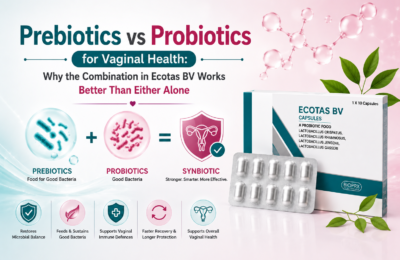
Ecotas BV includes Lactobacillus crispatus as a core component of its four-strain daily synbiotic capsule for vaginal health precisely because the evidence behind this strain is so strong and so consistent.
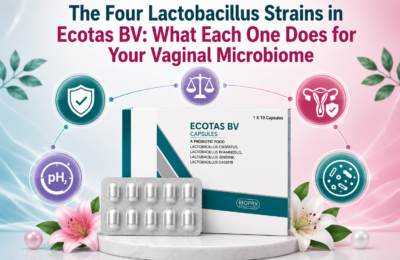
Alongside L. rhamnosus, L. jensenii, and L. gasseri, the L. crispatus in Ecotas BV contributes the foundational acid-hydrogen peroxide dual protection mechanism that the other strains complement and reinforce. Together, the four-strain combination mirrors the natural multi-species vaginal community that research identifies as the healthiest and most resilient.
A completed double-blind, randomised controlled clinical trial evaluated this exact four-strain formulation in adult women with BV confirming that the inclusion of L. crispatus alongside the other three strains provides measurably better microbiome support than narrower formulations.
The fructo-oligosaccharides (FOS) prebiotic in Ecotas BV for vaginal health feeds the colonising Lactobacillus strains including L. crispatus improving their survival and establishment through the gut-vaginal axis. The result is a daily capsule for vaginal health that actively works to restore and sustain the L. crispatus-dominant microbiome that scientists identify as the standard of vaginal protection.
The Bottom Line
Lactobacillus crispatus is not just the most studied vaginal probiotic strain it is, by almost every metric the science has, the most protective one. Its dual acid and hydrogen peroxide mechanism, its role as a biomarker of vaginal health, its clinical efficacy against BV and yeast infections, and its protective function during pregnancy set it apart from every other Lactobacillus species in the vaginal microbiome.
Restoring and maintaining L. crispatus dominance is one of the most evidence-based things you can do for your long-term vaginal health. Ecotas BV for vaginal health puts L. crispatus at the heart of a daily four-strain synbiotic formulation giving your microbiome the foundation it needs to protect itself, every single day.
Frequently Asked Questions
– Why is Lactobacillus crispatus considered the most protective vaginal strain?
Lactobacillus crispatus produces both lactic acid and hydrogen peroxide, a dual antimicrobial mechanism that no other vaginal Lactobacillus species matches consistently. It is also the only strain that reliably produces D-lactic acid, which research identifies as more protective than L-lactic acid alone. A vaginal microbiome dominated by L. crispatus (Community State Type I) is consistently associated with the lowest rates of BV, yeast infection, and reproductive complications across all published vaginal microbiome research.
– Can I increase Lactobacillus crispatus through diet alone?
Diet can support the overall vaginal microbiome. A diet high in plant fibre, fermented foods, and low in refined sugars supports healthy Lactobacillus populations generally. However, there is no reliable dietary route to specifically increase L. crispatus in the vaginal microbiome. The most evidence-based approach for restoring L. crispatus levels is daily oral supplementation with a daily capsule for vaginal health that contains the strain in a clinically viable form.
– Does Lactobacillus crispatus help with recurrent BV?
Yes. Clinical evidence shows that L. crispatus-based probiotic interventions halve BV recurrence rates compared to placebo. The mechanism involves both competitive exclusion of Gardnerella vaginalis from vaginal epithelial attachment sites and the acidification of the vaginal environment to levels that prevent BV biofilm reformation.
– Is Lactobacillus crispatus safe in pregnancy?
Yes. Lactobacillus crispatus is naturally dominant in the healthy pregnant vaginal microbiome. Research confirms that L. crispatus colonisation during the third trimester protects against Group B Streptococcus, a potentially serious pathogen for newborns. Probiotic supplementation containing L. crispatus is generally well tolerated in pregnancy, though you should always consult your obstetrician or midwife before starting any new supplement.
– How does Ecotas BV support Lactobacillus crispatus for vaginal health?
Ecotas BV for vaginal health includes L. crispatus as one of four targeted Lactobacillus strains, alongside a prebiotic (FOS) that improves colonisation. Taken as a daily capsule for vaginal health, Ecotas BV helps restore and sustain L. crispatus dominance in the vaginal microbiome through the gut-vaginal axis, providing the consistent, daily microbiome support that episodic treatment cannot.