Your vaginal microbiome does not exist in isolation. It is one of the most hormonally responsive ecosystems in the female body rising and falling with oestrogen, shifting across the menstrual cycle, transforming during pregnancy, and fundamentally reorganising during perimenopause and beyond.
Understanding the relationship between hormonal changes and vaginal microbiome health is not just academic. It is the key to understanding why infections like BV and yeast seem to track with certain times of the month, certain life stages, and certain hormonal events and what you can do to maintain protection through all of them.
The Oestrogen-Glycogen-Lactobacillus Axis: How Hormones Control Your Vaginal Flora
To understand how hormonal changes disrupt the vaginal microbiome, you first need to understand the mechanism that keeps it healthy in the first place.
Because oestrogen plays such a vital role in regulating the glycogen fuel needed for Lactobacillus to thrive and dominate, it is important to understand exactly how hormonal changes can influence the composition of the vaginal microbiome throughout different life stages.
The chain of events works like this:
- Oestrogen stimulates the cells lining the vaginal wall to produce glycogen a form of stored sugar
- Lactobacillus bacteria metabolise that glycogen and convert it into lactic acid
- Lactic acid keeps vaginal pH in the protective 3.8 – 4.5 range hostile to most pathogens
This means oestrogen is not just a reproductive hormone. It is the fuel supply for your vaginal microbiome’s protective bacteria. When oestrogen levels fall for any reason, at any life stage glycogen production drops, Lactobacillus populations lose their food source, lactic acid production slows, and vaginal pH rises. That rising pH is the open door through which BV-causing bacteria, Candida, and uropathogens enter.
The composition of the vaginal microbiome appears hormonally regulated, as evidence shows it adapts to hormonal changes in menstruation and menopause. In general, high steroid hormone levels tend to decrease the dominance of anaerobic bacteria and favour the dominance of Lactobacillus on the vaginal epithelium.
How Each Hormonal Phase Affects Your Vaginal Microbiome
During the Menstrual Cycle
Your vaginal microbiome shifts measurably across every phase of your monthly cycle often in ways that directly influence your infection risk.
Phase follicularis (pre-ovulatory): Increased oestrogen production promotes an acidic and lactobacilli-dominated milieu. This is generally when the vaginal microbial ecosystem experiences maximum stability and the least susceptibility to infection.
Luteal phase (after ovulation): Progesterone dominates, and some studies suggest this makes the microbiome slightly more diverse and is associated with a higher risk of thrush during this stage. The pre-period drop in oestrogen that occurs in the late luteal phase begins the glycogen decline that makes the vaginal environment more vulnerable.
Menstruation: Blood can temporarily raise vaginal pH, potentially reducing Lactobacilli and allowing other microbes to flourish. This explains why women have a higher risk of bacterial vaginosis during this stage. The good news: this heightened risk is usually temporary, and the microbiome typically rebalances quickly after menstruation has finished as long as Lactobacillus populations are robust enough to rebound.
During Pregnancy
Pregnancy brings a dramatic surge in oestrogen and progesterone. During pregnancy, the vaginal microbiome often becomes even more dominated by Lactobacillus, one of the body’s ways of protecting against ascending infection.
As pregnancy advances, elevated levels of circulating oestrogen are hypothesised to increase Lactobacilli species abundance. The withdrawal of oestrogen during the postpartum period is also assumed to precipitate a dramatic shift from a prior Lactobacillus-dominated microbiota to a diverse and non-Lactobacillus-dominated microbial profile in postnatal women.
This postpartum drop is one of the most significant and least discussed hormonal microbiome disruptions. New mothers, already dealing with sleep deprivation and immune adjustment, face a vaginal microbiome that has been dramatically restructured by the post-birth hormonal crash. Breastfeeding extends this oestrogen-suppressed state, keeping vaginal pH elevated and Lactobacillus populations lower for months.
During Perimenopause and Menopause
The most profound and sustained hormonal changes and vaginal microbiome disruption occur during the menopause transition. When oestrogen levels drop during perimenopause, glycogen supplies decline. The Lactobacilli lose their food source, lactic acid production slows, and vaginal pH rises. As the environment becomes less acidic, anaerobic bacteria species like Gardnerella or Prevotella, which cause bacterial vaginosis begin to multiply. This microbial shift is what sets the stage for dryness, itching, pain during sex, and more frequent vaginal or urinary infections, which we associate with the perimenopause transition.
Increased vaginal pH caused by reduced oestrogen alters the vaginal microbiome, resulting in reduced levels of Lactobacillus. Such changes influence the vaginal structure and functions, contributing to the onset of genitourinary syndrome of menopause.
The reduction of circulating female hormone levels in women approaching menopause triggers various physiological changes: vulvovaginal atrophy, dryness, itchiness, redness, loss of elasticity, inflammation, and atypical secretions are all changes in the vagina as oestrogen and progesterone levels decrease in the circulation.
Hormonal Contraception
The effect of hormonal contraception on the vaginal microbiome is more nuanced than either “good” or “bad”; it depends on the type and delivery method.
Combined oral contraceptives that stabilise oestrogen levels tend to support Lactobacillus dominance by preventing the dramatic oestrogen fluctuations that destabilise the microbiome across the cycle. Women on the pill often report fewer recurrent BV episodes precisely for this reason.
Use of a locally released progestin contraceptive appears to lead to vaginal microbiome alterations and loss of Lactobacillus species. Progesterone-only or progestin-dominant methods including some implants, hormonal IUDs, and certain injections may therefore carry a different microbiome impact than combined methods.
What Hormonal Microbiome Disruption Looks Like in Practice
The clearest signs that hormonal changes and vaginal microbiome shifts are affecting you include:
- Recurrent BV or yeast infections that track with your cycle (before or during your period, or in the luteal phase)
- Vaginal dryness, irritation, or odour changes that worsen after childbirth or during breastfeeding
- New or worsening vaginal symptoms in perimenopause dryness, recurrent infections, or discharge changes
- A pattern of yeast infections in the week before your period
- Increased vaginal sensitivity after starting or changing hormonal contraception
None of these experiences are inevitable, even through major hormonal life transitions. Understanding the mechanism and actively supporting the Lactobacillus populations that oestrogen normally sustains is the most direct way to reduce their frequency and severity.
Steps You Can Take to Safeguard Your Vaginal Microbiome During Hormonal Fluctuations
1. Support Lactobacillus Daily Not Just During Infections
The most important principle in managing hormonal changes and vaginal microbiome disruption is consistency. Lactobacillus populations need to be maintained at levels high enough to withstand the periodic drops that hormonal fluctuations cause. That requires daily support not reactive supplementation when symptoms appear.
A daily synbiotic capsule for vaginal health that includes clinically validated vaginal Lactobacillus strains gives your microbiome a consistent population top-up across every phase of every cycle and throughout every hormonal life transition.
2. Discuss Vaginal Oestrogen With Your Healthcare Provider if Perimenopausal
Topical oestrogen administration increases vaginal Lactobacillus in postmenopausal women making local vaginal oestrogen one of the most evidence-based interventions for menopausal vaginal microbiome restoration. Unlike systemic HRT, it acts locally. Discuss this option with your GP or gynaecologist if you are experiencing significant menopausal vaginal changes.
3. Avoid Microbiome Disruptors During Vulnerable Phases
During the luteal phase, menstruation, the postpartum period, and perimenopause when Lactobacillus populations are already under pressure microbiome disruptors cause disproportionate damage:
- Douching removes whatever Lactobacillus bacteria remain during hormonally vulnerable phases never use internal vaginal washes
- Scented intimate products fragranced wipes, tampons, and gels all irritate the vaginal mucosa and further destabilise pH
- Antibiotics without probiotic support every antibiotic course depletes Lactobacillus, amplifying any existing hormonal vulnerability
4. Time Probiotic Support Strategically
If you experience cycle-linked BV or yeast infection, consider:
- Maintaining daily probiotic supplementation throughout the cycle not starting only when symptoms appear
- During the postpartum period, beginning a daily synbiotic as soon as possible after delivery to support the dramatic microbiome shift that accompanies the post-birth oestrogen crash
How Ecotas BV Supports Your Vaginal Microbiome Through Every Hormonal Phase
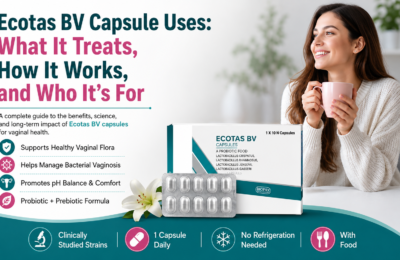
Ecotas BV for vaginal health is designed as a daily synbiotic capsule specifically for the kind of continuous microbiome support that hormonally driven disruption demands.
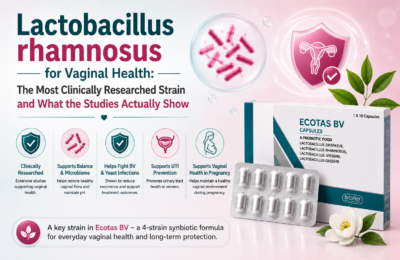
The four Lactobacillus strains in the Ecotas BV daily capsule for vaginal health are the species that naturally dominate the healthy vaginal microbiome and the species most depleted when oestrogen drops:
- L. crispatus the primary producer of both lactic acid and hydrogen peroxide; the species most correlated with a healthy, stable vaginal microbiome at every life stage; particularly important during the postpartum and perimenopausal phases when its natural populations fall most dramatically
- L. rhamnosus resilient through digestive transit and sustained across hormonal fluctuations; supports Lactobacillus recovery after both menstruation and antibiotic-driven depletion
- L. jensenii a native vaginal resident that contributes lactic acid production and competitive bacterial exclusion; naturally abundant in healthy premenopausal women and depleted in menopausal dysbiosis
- L. gasseri produces biosurfactants and bacteriocins; among the three dominant species in the healthiest vaginal community types; one of the species whose relative abundance drops in women with short cervix during pregnancy, signalling its importance in reproductive-phase microbiome stability
The fructo-oligosaccharides (FOS) prebiotic in the formula provides a direct food source for all four strains partially compensating for the glycogen reduction that falling oestrogen causes at every hormonal transition point. This is especially valuable during the luteal phase, postpartum period, and perimenopause exactly the windows when glycogen availability naturally decreases.
Ecotas BV for vaginal health is not a treatment for any specific hormonal condition but as a daily capsule for vaginal health, it is the most practical, evidence-informed step any woman can take to maintain Lactobacillus dominance through the hormonal changes that will, inevitably, come.
The Bottom Line
Your vaginal microbiome is a hormonally responsive ecosystem and every significant hormonal change in your life creates a period of microbiome vulnerability. From the monthly cycle to pregnancy to perimenopause, hormonal changes and vaginal microbiome disruption are inseparable but they are not unmanageable.
Understanding the oestrogen-glycogen-Lactobacillus axis means understanding exactly what your protective vaginal bacteria need, and when they are most likely to fall short. A daily synbiotic capsule for vaginal health gives those bacteria consistent support through every hormonal phase before disruption leads to infection, not after.
That daily commitment is exactly what Ecotas BV for vaginal health is built to support.
Frequently Asked Questions
How does hormonal change affect the vaginal microbiome?
The relationship between hormones and vaginal microbiome is strongly connected by the estrogen-glycogen-Lactobacilli axis. When oestrogen falls during the late luteal phase, menstruation, postpartum period, or perimenopause glycogen production in the vaginal lining decreases. Lactobacillus bacteria lose their fuel source, populations drop, lactic acid production slows, and vaginal pH rises. That pH rise creates the conditions for BV, yeast infections, and UTIs to establish.
Why do I get BV or yeast infections at the same point in my cycle every month?
This pattern usually reflects a hormonal microbiome vulnerability at a specific cycle phase. Pre-period BV typically correlates with the late-luteal oestrogen dip; yeast infections in the luteal phase often reflect the progesterone-driven microbiome shift and rising glycogen that Candida exploits. Tracking symptoms alongside your cycle helps identify your personal pattern and makes the case for daily, continuous probiotic support rather than reactive treatment.
Does menopause permanently change the vaginal microbiome?
Significantly, yes but not irreversibly. The continuous fall of oestrogen levels due to menopause leads to a persistent fall in the dominance of Lactobacilli as well as increased vaginal pH in the postmenopausal period. On the other hand, vaginal oestrogen preparations and daily intake of Lactobacilli probiotics have been demonstrated to reverse the fall in the population of Lactobacilli as well as vaginal pH.
Does the contraceptive pill affect vaginal flora?
It can, though the effect varies by contraceptive type. Combined oral contraceptives that stabilise oestrogen levels tend to support Lactobacillus dominance and may reduce cycle-linked BV recurrence. Locally released progestin-only contraceptives appear to lead to vaginal microbiome alterations and loss of Lactobacillus species so women switching to progestin-dominant methods may notice increased vaginal symptoms. A daily capsule for vaginal health can help maintain Lactobacillus populations regardless of contraceptive type.
Is it safe to take an Ecotas BV probiotic through hormonal transitions like pregnancy or menopause?
The Lactobacillus strains in Ecotas BV for vaginal health are naturally present in the vaginal microbiome at every life stage. The formulation is designed for daily use and is well tolerated. As with any supplement, always consult your healthcare provider before starting during pregnancy, postpartum, or while managing specific perimenopausal conditions.